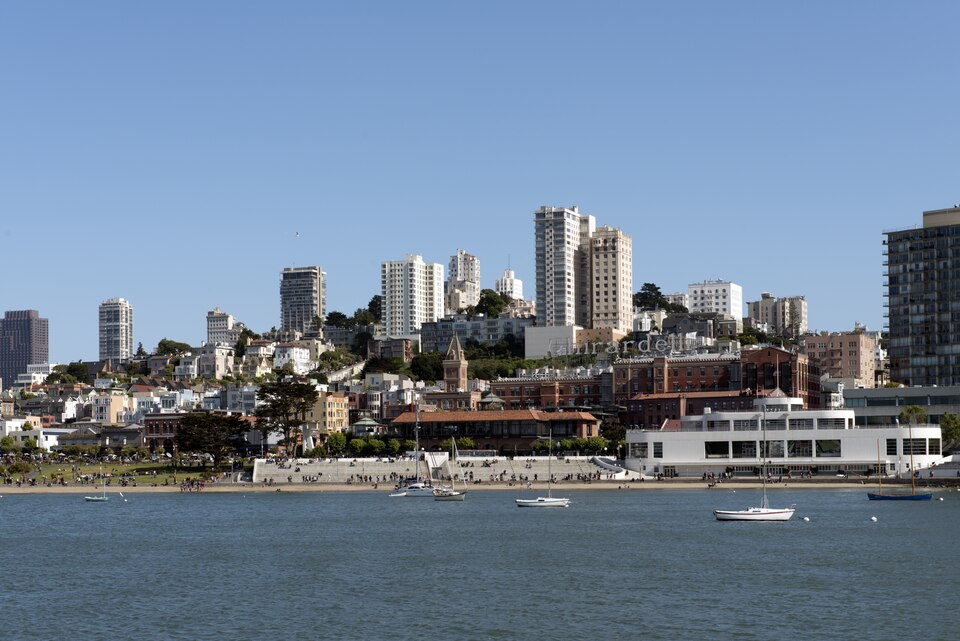
Ghirardelli Square collectible travel card

Home / Destinations / San Francisco / Ghirardelli Square

San Francisco9 min

Ghirardelli Square

The Ghirardelli chocolate factory occupied a full block near Fisherman's Wharf from 1893, after Domingo Ghirardelli's sons bought the old Pioneer Woolen Mill. Production moved to San Leandro in the early 1960s. William Roth and his mother Lurline bought the site in 1962 and reopened it in 1964 as Ghirardelli Square, one of the first adaptive reuse projects in the United States.

9minute listen
4sources
12chapters
3.99 XCto unlock
San Francisco · 9 min listen · 4 sources

Quick answer

The Ghirardelli chocolate factory occupied a full block near Fisherman's Wharf from 1893, after Domingo Ghirardelli's sons bought the old Pioneer Woolen Mill. Production moved to San Leandro in the early 1960s. William Roth and his mother Lurline bought the site in 1962 and reopened it in 1964 as Ghirardelli Square, one of the first adaptive reuse projects in the United States.

1Domingo Ghirardelli was born in Rapallo, Italy in 1817 and apprenticed to a Genoa confectioner
2The company took over the Pioneer Woolen Mills on North Point Street
3Domenico Ghirardelli purchased the entire city block in 1893

Full transcript

1

A Block That Has Had Three Lives

Ghirardelli Square is not one building. It is a full block of brick that has carried three working lives, and each one left fingerprints you can read with your eyes. Start with the oldest layer and listen to the arguments underneath. The shape of the lumber industry, the rise and fall of a chocolate dynasty, the invention of a preservation idea — the whole sequence fits inside the walls around you. Walking through the lower plaza, look up at the patchwork of brick heights. Nothing lines up evenly, because no single architect ever drew the whole block. Each owner added what they needed and stopped. The result is the exact opposite of a mall designed from a single blueprint, and that is the point. Look at the patchwork of brick heights and notice how each section stops where the last owner ended.

2

Domingo's First Confection, Then His Block

…

3

The Woolen Mill That Came Before

…

4

The Clock Tower and What Was Said About It

…

5

Why the Chocolate Left

…

6

The Argument That Saved the Block

…

7

The 1964 Opening

…

8

The Legal Layer Around You

…

9

The Chocolate That Does Still Get Made Here

…

10

What You Can Still Find Underground

…

11

Reading the Courtyard You Are Standing In

…

12

Look Back at the Block You Just Walked

…

Deep-dive audio

  1. 1A Block That Has Had Three Lives0:47Free preview
  2. 2Domingo's First Confection, Then His Block1:01Unlock to listen
  3. 3The Woolen Mill That Came Before0:53Unlock to listen
  4. 4The Clock Tower and What Was Said About It0:59Unlock to listen
  5. 5Why the Chocolate Left0:46Unlock to listen
  6. 6The Argument That Saved the Block0:52Unlock to listen
  7. 7The 1964 Opening0:44Unlock to listen
  8. 8The Legal Layer Around You0:33Unlock to listen
  9. 9The Chocolate That Does Still Get Made Here0:38Unlock to listen
  10. 10What You Can Still Find Underground0:32Unlock to listen
  11. 11Reading the Courtyard You Are Standing In0:42Unlock to listen
  12. 12Look Back at the Block You Just Walked0:41Unlock to listen
Open in maps
Opens a search for this place — no app install, no account.

After the guide

Practical bookings for this stop. These are affiliate links: they cost you nothing extra and they do not change what we recommend.

Data that works on landing

Get a local eSIM →

Backup eSIM option

Compare eSIM plans →

Museum and attraction tickets

Book timed-entry tickets →

Multi-attraction city pass

Compare attraction passes →

Frequently asked

Is chocolate still made here?
No. Manufacturing moved across the bay to San Leandro in the early 1960s and stayed there. What remains on the block is the brick shell of the plant, the illuminated rooftop sign, the clock tower and the retail store on the ground floor. The rest of the complex is shops and restaurants.
Who was Domingo Ghirardelli?
A confectioner born at Rapallo, near Genoa, in 1817. He trained in Italy, ran a shop in Lima, Peru, and reached California in 1849 hoping to sell sweets to gold miners. By 1852 he had premises in San Francisco. His name still sits on one of the oldest continuously operating chocolate firms in the country.
What does adaptive reuse mean?
Keeping an old building and giving it a new job instead of knocking it down. When the Roth family reopened the disused plant as shops and restaurants in 1964, working with landscape architect Lawrence Halprin and the firm Wurster, Bernardi and Emmons, the result became the American template for the idea.
Is the square legally protected?
Yes. San Francisco designated it a city landmark in 1970, and it joined the National Register of Historic Places in 1982. That status covers the brick factory buildings, the clock tower and the terraced plaza, which is why the complex still reads as a nineteenth-century industrial block rather than a modern mall.

This one is a deep dive

A 9-minute deep dive: 12 chapters with text and audio. Chapter one previews at no charge; the rest unlocks once.